I have a DECstation 220 (an Olivetti M250E under the covers) that needs repair. I have a pocket service guide, but I have not found any other documentation. Is there any?
Thanks
Rob
As it looks like I am not going to be able to repair the monitor board for
my VAXmate I am wondering if I can do anything with the outputs from the I/O
board to drive an external monitor instead.
The connector to the monitor board has RGB+Intensity outputs at TTL levels.
The horizontal sync has a frequency of 26.6KHz, active low with the high
voltage 3.7V, Vertical sync is 60Hz. I don't believe that corresponds to any
known standard, does it?
I had a go at building this
http://www.dasarodesigns.com/wp-content/uploads/2014/03/pet-composite-video-
adapter.jpg feeding its output to a composite to VGA device to see if it
would convert it to VGA, but no luck.
Any ideas?
Thanks
Rob
Just bought an Extron RGB-HDMI 300 (A) that handles VGA and other RGB type signals and has HDMI output. I've connected it to my VAXstation 4000/60 (very successfully), and my IIgs (reasonable but this is at the low end of what the unit can manage). Output on either my Sony 46" TV or Apple 1600x1050 monitor. Found one (pull from service) at surpluscrestron.com for $53 shipped. It didn't come with the power supply (12 V @ 1 A) and needed this connector (https://www.digikey.com/product-detail/en/molex/0395000002/WM7732-ND/1280583) to attach the power supply.
>
> Date: Sat, 23 May 2020 07:07:52 -0700
> From: Al Kossow <aek at bitsavers.org>
> Subject: Early Nubus history
>
> Did anyone ever do any research into the early history of Nubus, wrt
> Western Digital, TI or Steve Ward/MIT/Numachine?
>
I was a member of the IEEE-1196 committee that wrote the NuBus standard and
IEEE-1101 committee that wrote the mechanical standard for the NuBus. Eike
Waltz and I did a lot of the mechanical standards work.
The members of the IEEE-1196 committee were George White (Chairman) R.
Gordon Cook, Mark Garetz(CompuPro and IEEE-696), Richard Greenblatt(MIT AI
Lab, LMI Founder), Ron Hochsprung(Apple), Richard Kalish, Rikki Kirzner(
Dataquest), Gerry Laws(TI), Rae Mclellan(Bell Labs), Gregory
Papadopoulos(MIT), Dan Schneider, Dave Stewart, Michael Thompson(me), Jim
Truchard(Founder National Instruments), Eike Waltz, *Steve Ward*(MIT), and
Fritz Whittington.
George White went from MIT->Computer Automation->Western
Digital->TI->Corollary->Intel. Corollary's cache technology was licensed by
DEC and many others.
My memories of this committee are a little vague after 40 years, other than
being very impressed with the other members. I will see if I kept any notes
>from the meetings.
--
Michael Thompson
Here's my conclusion to the H960 stabiliser feet thread from a while ago where I was after measurements of
the originals. And thanks for all the help from cctalk (especially Noel) who supplied dimensions and photos.
I finished these last year but moved on to other projects and hadn't returned to the list to discuss them,
so I am doing that now. I made a pair each for my two H960's.
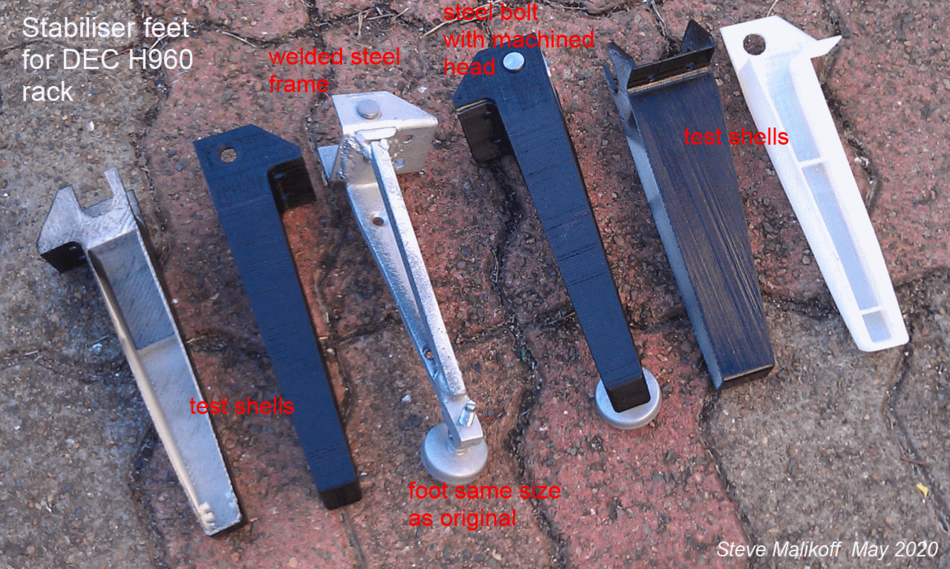
The feet consist of welded steel load-bearing frames with a C-profile that fits snugly onto the H960
base, a lower leg from a shelf bracket and a support strut. The leg is located by a steel bolt. The
bolt has the head machined to a disc, I was going to turn the taper and machine the slot but I lost
the photo of the original bolt that a listmember had posted so I left them at that. They could do with
nickel electroplating sometime. The frame is super strong, although I have not physically loaded them
to any great extent.
The outer end has a threaded adjustable pad the same size (AFAIK) as the originals, which are still
available. I found some correct size el-cheapo ones at the hardware store that did the job just fine.
The frame is threaded for the pad post and a nut on the pad then locks the pad from turning.
The outside aesthetics are taken care of with a 3D printed hollow shell modelled from the measurements
of the original casting. It slides onto the leg and is secured by the bolt. The shell CAD model still
needs some work to get the fit and front holes right, and a few other things but overall they look
fine and obey the 6 foot rule. A few coats of satin black enamel helps hide the print layering a bit.
Photo showing the frame (spray finished in silver epoxy primer, what I had at hand), the other frame
inside a shell, and some of the test shells:
http://www.surfacezero.com/g503/data/500/Stabiliser_feet_01.png
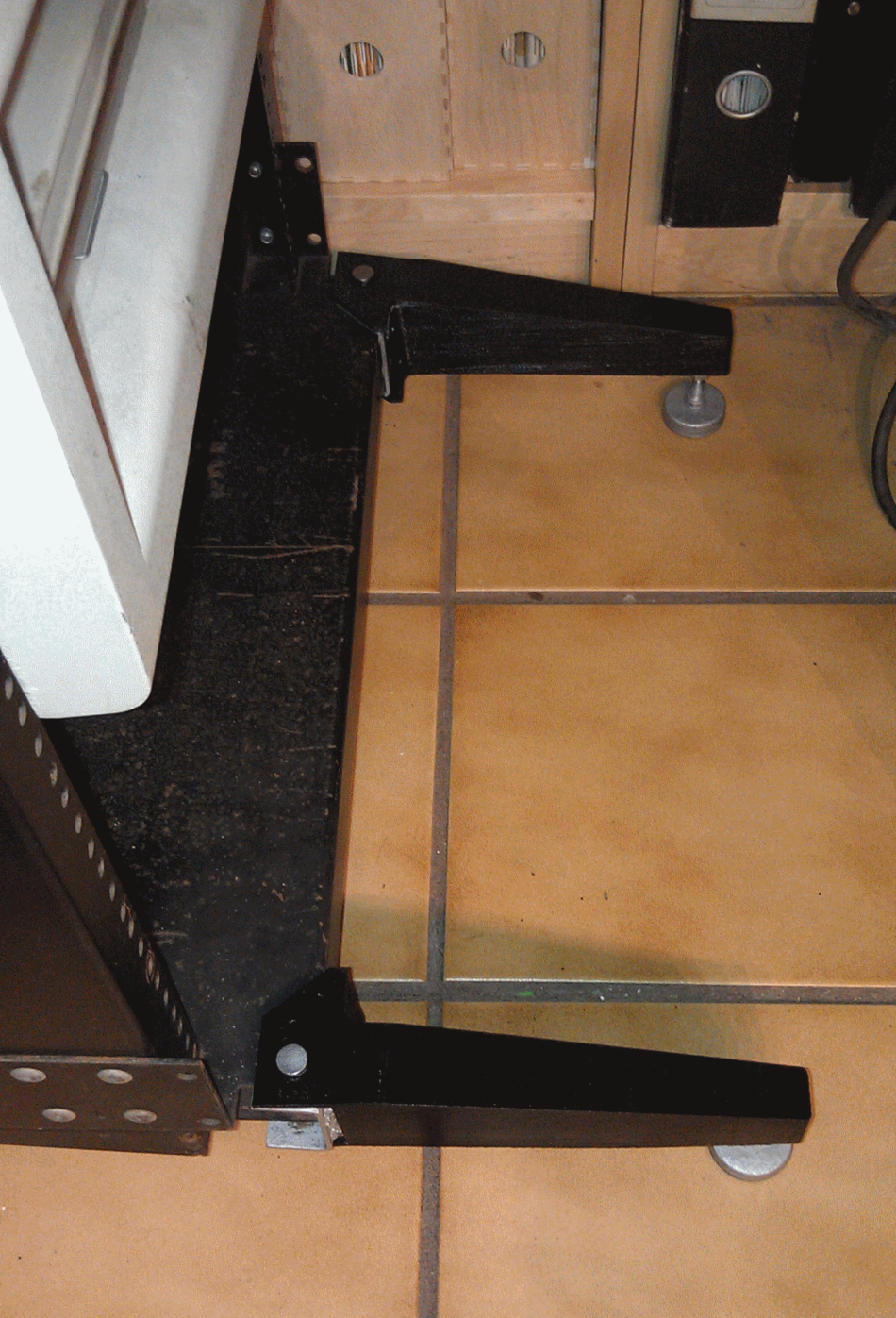
As attached to one of the H960s. (I have yet to do the kick panel, may laser cut that sometime):
http://www.surfacezero.com/g503/data/500/Stabiliser_feet_02.png
Steve.
With the 11/83 running pretty well I decided it was time to derack it
and try putting in a TK50 tape drive. I have two and a TQK70 controller
(which should work with a TK50) so I popped it in and started to test.
On the first unit the tape was already loaded and "stuck". Cleaned the
head by lifting it up, cleaning with isopropyl alcohol on clean no-lint
swabs and it unloaded properly. Now loads and unloads with no issues on
two tapes.
Second unit was a bit more interesting, even with a clean head it would
not unload. It would spin the tape, get to the point where the leader
was on the way through the head system then it would blink endlessly.
Took it out and moved the tape with a screwdriver through the hole and
found the problem:
The leader tongue had bent backwards a bit and as a result it was
getting caught in the head slot when rewinding. The TK50 controller must
be smart enough to detect the increased torque and stopped before
ripping the tongue through. I took it off, bent it back to straight, put
it in and now the tape loads and unloads properly.
I wonder if later model LTO tape units have the same tongue and leader
and can be swapped into a TK50.
Another question: Under RT11 what device is a TK50? Is it MQ or
something else? And is there a utility to allow a TK50 to be written
>from a SIMh image to real tape like PDP11GUI?
Thanks!
Chris
As I wrote in my last post, but write here for use as a separate thread:
I'd be interesting in hearing from folks what toolsets they have used
for HDL (VHDL in particular). I started with Xilinx ISE and then
graduated to Vivado for later chipsets - unfortunately, Vivado seems to
be something of a dog, in terms of time to compile HDL and synthesize logic.
JRJ
> From: Fred Cisin
> we can start by considering the 4004. 1971. ... Then came the 8008,
> with EIGHT bit data bus, and 14 bit address bus (16K of RAM) ... It is
> important to note that each Intel chip consisted of "minor" modifications to
> the previous one.
I know you didn't _say_ the 8008 was based on the 4004, but your text
can give that impression.
"The [8008] was commissioned by Computer Terminal Corporation (CTC) to
implement an instruction set of their design for their Datapoint 2200
programmable terminal. As the chip was delayed and did not meet CTC's
performance goals, the 2200 ended up using CTC's own TTL-based CPU instead."
The 8008 was started before the 4004, but wound up coming out after it. (See
Lamont Wood, "Datapoint", pg. 73.) This is confirmed by its original name,
1201 - the 4004 was going to be named the 1202, until Faggin convinced
Intel to name it the 4004.
Noel
Hi,
Every now and again I have a bit of time to mess with old computers - and usually for whatever reason - its Sun machines for me.
I?ve had loads over the years, played with them and passed them on.
Does anyone have anything old Sun wise available in the UK? I?d love to find an old VME bus machine but anything old or interesting. I can travel
to pick stuff up etc, social distancing observed of course :D
Anyway - PM me if you have anything that?s restorable :)
Cheers
Ian