I have a couple of LK401 keyboards and they generate a 'keyboard error -
4' error on power up test when attached to a VT420.? The problem seems
to be one or more keys that are 'stuck on'.
When the keyboard is turned upside down and shaken I can get the self
test to pass.
Is it possible to open the keyboards and repair this type of problem?
I also have LK411 keyboards that have a PS/2 type of connector, is there
an adapter to let me use these keyboards instead of the LK401s?? Are the
signals the same, only the connectors being different?
Doug
I wrote:
>> While the definition of the term "personal computer" varies depending
>> on who is using the term, these machines, and others like them, were
>> designed to be used at a much more personal level than the
large-scale
>> mainframe machines housed in the glass-walled rooms where only
"special" people were allowed
>> anywhere near them.
^^^^^^^^^^^^^^^^^^^^^^^^^^^^^^^^^^
^^^^^^^^^^^^^^^^^^
To which, Rich A. replied:
>This, like "Multics never got out of the lab", is a bogo-meme.
(Thanks, Neil!)
> People did not *need* to get near the mainframes in order to do their
jobs, unlike the jobs for which the small systems
> (and you forgot the PDP-11 in your list) were created. Most
programming on mainframes was special purpose, batch oriented, data
>processing connected to accounting systems (GL/AP/AR/PR), and a lot of
the rest was high intensity engineering (where at this level >even
physics is engineering) which needed lots of data handling for short
runs.
Yeah...I can agree with that. But, part of the talk was about getting
"up close" with the computer, at a personal level - hands-on.
The glass-walled room machines weren't that way, and thus weren't
considered "personal computers", for just the reason you mentioned --
the work typically done on them was of a different class of work that
didn't require any kind of hands-on activity with the machine (except
for the operators, who loaded up the jobs, managed the tapes, and
gathered the printouts).
The discussion had gone from talk about the IBM 709/709X computers,
which were more "glass room" type machines, to discussion about personal
computers. I suffered some angst over the discussion of machines like
Apple IIs or even Altair 8800's as the first personal computers, when in
fact, the general term applied to computers that came long before these
machines.
Perhaps the glass-room meme isn't so much bogus, as it is a sign of the
cultural times. In those days, the big machines were very expensive,
and required a lot of support -- that meant special power, air
conditioning, raised floors, and highly-trained people. The
"management" of these big machine installations had a lot at stake...and
as such, they were very protective of their machines, which is most of
the reason they were encased in glass (they needed to be glass to be
able to show them off without letting people in...in the days, big
computer installations were class icons).
It wasn't really so much that the work that the consumers (I wouldn't
use the word "users" to describe them, because they were never really
"using" the machine) of the results of the machines didn't need to have
access to the machines...it was more because the management only wanted
those who had all the necessary training and knowledge operating the
machines to assure the maximum amount of productivity for their
multi-million dollar investments to gain the best return on that
investment, as well as safety for these "delicate" machines.
As for the PDP-11, it was indeed a significant omission. Honestly, I
ran out of time. I missed the PB 250, which certainly should have been
on the list, and the PDP-11...and I'm sure that there are quite a number
of other machines that were missed.
Compiling a full list of this class of machines, even during this
somewhat limited time period, would be a daunting process. There were
many companies that popped up in the 1960s, along with those from
established computer makers, that marketed small computers that were
generally intended to be used on a single-user basis, by individuals.
Examples off the top of my head are Computer Automation (PDC-808), Smith
Corona/Marchant SCM 7816, 3M (yes, the adhesive people) 2018, Control
Data 160/160-A, Digital Equipment PDP-1, HP 2100-series, Data
Acquisition Corp. DAC-512.....it could go on and on.
I was writing my message as I was getting ready to head off to work, and
had to stop before I ended up being late.
-Rick
---
Rick Bensene
The Old Calculator Museum
http://oldcalculatormuseum.com
The ebay seller of this IBM 360/40 front panel asked me if I could put a link on the list. So here it is:
https://www.ebay.com/itm/IBM-360-model-40-mainframe-CPU-Operator-panel/1527…
Disclaimer: I am not affiliated with the seller other than he has contacted me after seeing one of my own videos about a 360/50 front panel.
Marc
I'm not sure where one might normally expect to discuss research
operating systems from the 1980s and 90s, but since it ran on Sun-2
through Sun-4 and DECstations, I'll start here.
I have the Sprite disk image for the DECstation 5000/200 running under
GXemul (see https://github.com/OSPreservProject/sprite), but this is a
minimal ~80MB image. I'm wondering if anybody has already gone through
the exercise of figuring out how to create a new disk image large enough
to, for example, load the source tree and see how far it is from compiling.
My calendar is full until mid-December, so I won't be taking a swing at
this in the next few weeks. But I had a moment and thought I'd start
asking if anybody's been down this road in the past decade or two.
Thanks,
--S.
Please, everyone, I do actually know of BitSavers; you don't need to point me
at it.
When I said:
>> I could look at the engineering manuals, but I was hoping for something
>> in between them and Bashe et al.
I assumed everyone would understand that by "engineering manuals", I was
meaning the kind of things one finds in BitSavers.
Noel
> From: Ben Franchuk
> Multics never really made it out of the lab.
This 'bogo-meme' (to use a word I coined) is, well, totally flat wrong.
Multics was a reasonably successful product for Honeywell from the end of
1972 (when the H6180 was introduced) to around 1987 (when they stopped
selling the DPS8/M, which had been introduced at the end of 1982). At its
peak, in 1985, there were almost 100 Multics sites.
MIT ceased to be involved in Multics development in 1977.
Multics died not because it was a failure (indeed, many systems kept running
for years, because the users liked it so much - the last one only shut down
in 2000), but because of Honeywell's incompetence at the computer business.
(That incompetence eventually resulted in a decision - probably correct from
the _business_ point of view, given said incompetence - to get out of the
computer business.)
More here:
http://multicians.org/myths.html
and
http://multicians.org/hill-mgt.html
(which discusses the high-level corporate politics behind the decision to
can Multics).
Noel
> On Nov 15, 2017, at 1:00 PM, cctech-request at classiccmp.org wrote:
>
> ------------------------------
>
> Message: 4
> Date: Tue, 14 Nov 2017 15:56:31 -0800
> From: "Mark J. Blair" <nf6x at nf6x.net>
> To: "General Discussion: On-Topic and Off-Topic Posts"
> <cctalk at classiccmp.org>
> Subject: WTB: HP-85 16k RAM Module and HPIB Floppy Drive
> Message-ID: <0CB24DF8-6D74-4A25-9263-73B24EB19487 at nf6x.net>
> Content-Type: text/plain; charset=us-ascii
>
> I just got my HP-85 working for the first time over the weekend (except for its tape drive, which is still a work in progress). I'd like to acquire some accessories for it:
>
> 1) HP 82903A 16k RAM module
>
> 2) HP 9122C dual 1.44M 3.2" floppy diskette drive
>
> Do any of y'all have either of those items available for swap or sale? I'm located in southern California.
>
> Those two items are at the top of my HP-85 want list, but I might also be interested in other related bits such as the 82940A GPIO Interface, other compatible HPIB mass storage, etc.
>
> --
> Mark J. Blair, NF6X <nf6x at nf6x.net>
> http://www.nf6x.net/
>
>
>
> ------------------------------
>
Hi Mark,
I believe that I have both of those things available.
If you?re interested, please contact me at: stephen.m.pereira.sr AT gmail DOT com
smp
- - -
Stephen Pereira
Bedford, NH 03110
KB1SXE
Having picked up one of these little TI Compact Computer-40 (cc40) units
over the Summer, I thought I'd work on reverse engineering a RAM
cartridge for the unit.
As shown on this forum:
http://atariage.com/forums/topic/255728-the-compact-computer-40-cc40/?p=389…
The design *appears* to havea? "floating" ground when powered off
battery alone.? The cartrridge edge connector has 2 grounds.? I didn't
think anything about them at first, assuming they were connected to each
other.
Hwoever, someone with a RAM cart is helping me reverse engineer, and it
appears pin 1 ground is connected to the RAM GND pin, but is connected
via a 6K8 resistor to the 3V battery ground, which is connected to pin
27 ground line.
I *assume* this means that, once the cart is pulled, the battery voltage
sits somewhere in the middle of the 5V swing the RAM needs to see, but I
can;t figure out how one calculates the voltage divider value for the
inherent resistance of an SRAM, as the 3V is sent through a germanium
diode (bringing the effective Vcc of the SRAM to 2.7V), and then SRAM
ground is sent through the 6K8 to battery ground.
Obviously, reverse engineering being fraught with errors, we could be
wrong, but assuming not, what is going on in this circuit, and how does
one calculate the effective potential of the GND pin of the SRAM?
Pics:
http://www.go4retro.com/downloads/CC40RAM/
Jim
--
Jim Brain
brain at jbrain.comwww.jbrain.com
All,
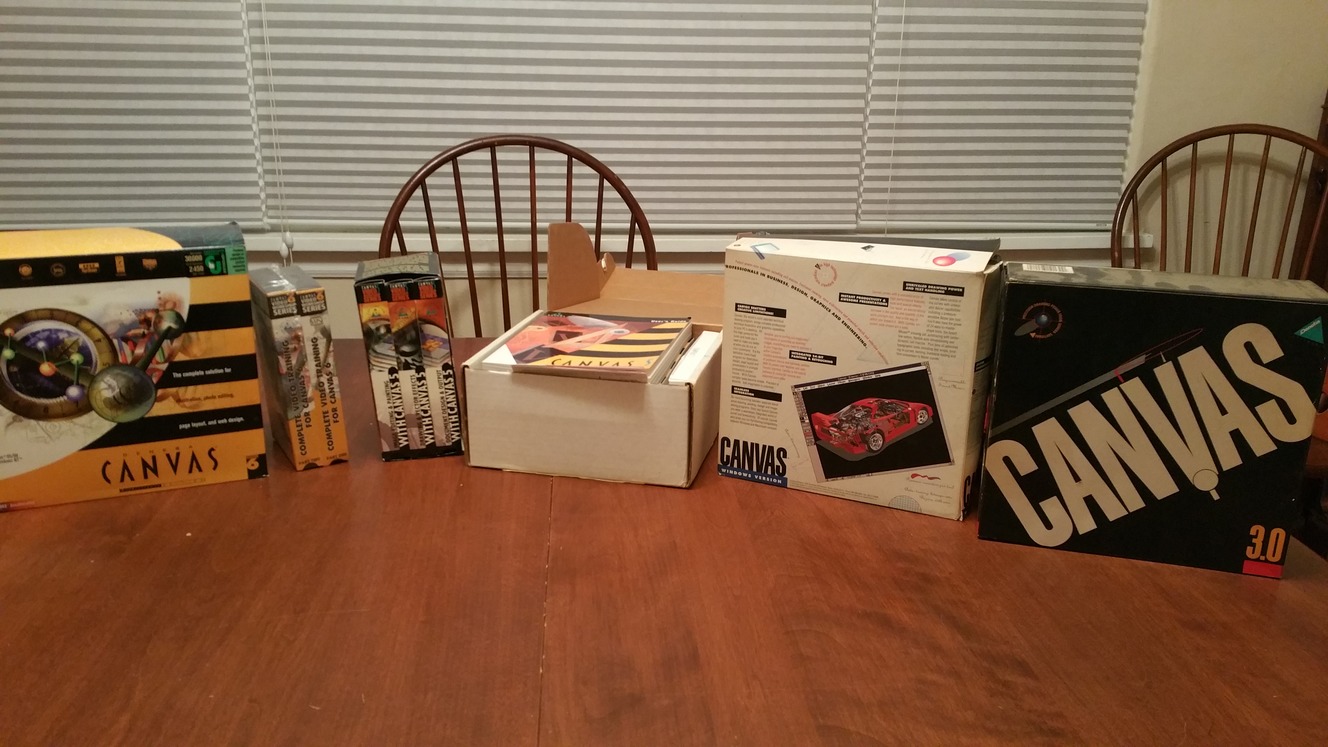
I picked up a big lot of stuff this past weekend.? Amongst the pile of
quite desirable Apple items (Feb '84 Macintosh!!!) were versions of
"Canvas" graphics software for Windows.? Boxed versions of Canvas 3, 5
and 6.
Free if anyone wants it.? Comes with training material on VHS tapes!
I'm not inclined to waste the shelf space on these myself. Pickup in
Seattle or? I guess I'll ship it if you have a burning desire for it.
http://archives.smbfc.net/uploads/retrocomputing/tmp/re_20171114_193434.jpg
--Jason