At 06:11 PM 9/28/2026, Jim Davis via cctalk wrote:
>AI is that second set of eyes.
>Out googles google and cuts down on searching for obscure stuff.
>I can't complain about paying $20 a month to openai so
>I don't get the dreaded "come back in 8 hrs" message.
>It's the only sub I have.
Yeah, it's insane. It's great fun for chewing on all those
"someday I'd like to..." retrocomputing dreams.
I just snapped my fingers and asked for an emulation of a Terak
hosted on a web site that runs in a visitor's browser, and it
worked the first time.
- John
I am looking to acquire period paper copies of the LispM manual and/or Symbolics manuals. Searches have turned up naught to this point. Any pointers would be appreciated.
With my new friend Claude, I've advanced the state of Terak emulation.
Working from Sergey Svishchev ("Shattered")'s fork of Open-SIMH,
we added support for double-density QB disk images and made
a number of other improvements.
We built a Python GUI for the emulator, making it easy to set the
volumes in the drives. Handles Terak, RT-11, UNIX V6.
Handles logical and physical sector layouts.
There's a disk browser and catalog system, recursively indexes
your folders of disk images, lets you add notes to disks and folders,
pictures of disk labels, rebuilds a static HTML version of the
catalog. Lets you easily find files, helps distinguish between
versions of files and where they are, looks inside p-System
libraries, has a p-Code disassembler, a p-System text viewer,
a CHARSET viewer, can view various Terak bitmap image formats like FOTO
and IMAGE, handles the MOVIE format, handles the vector renderings
from disks I got from Paul Haeberli. Saves things as PNG, MP4 or
SVG as appropriate. There's a movie recorder to save your full
interactive emulated session, too. There's an octal / hex viewer,
a dump as numbers tool, a "strings" tool, a dumper / disassembler
for p-Code, PDP-11, RT-11, and a.out / .o / .a .
There's an emulated Printronix P300 printer with graphics on the serial port.
Sound works, both beep and PCM. There's an emulated GSW / Plato music box
for the one demo disk on Bitsavers.
Along the way, Claude rediscovered a floating point bug that lived in
Supnik's SIMH from 2004 until 2023, but that hadn't been folded into
Sergey's fork.
I suspect Dave Plummer of YouTube's "Dave's Garage," (1.15M subscribers)
will be talking about Teraks soon, as he recently received a working one
and a spare from Prof. Tim Teitelbaum of Cornell.
I have not yet put it on the Github, but if you'd like a peek,
send me an email.
- John
https://www.threedee.com/jcm/
"Geek Site of the Day" October 16, 1996
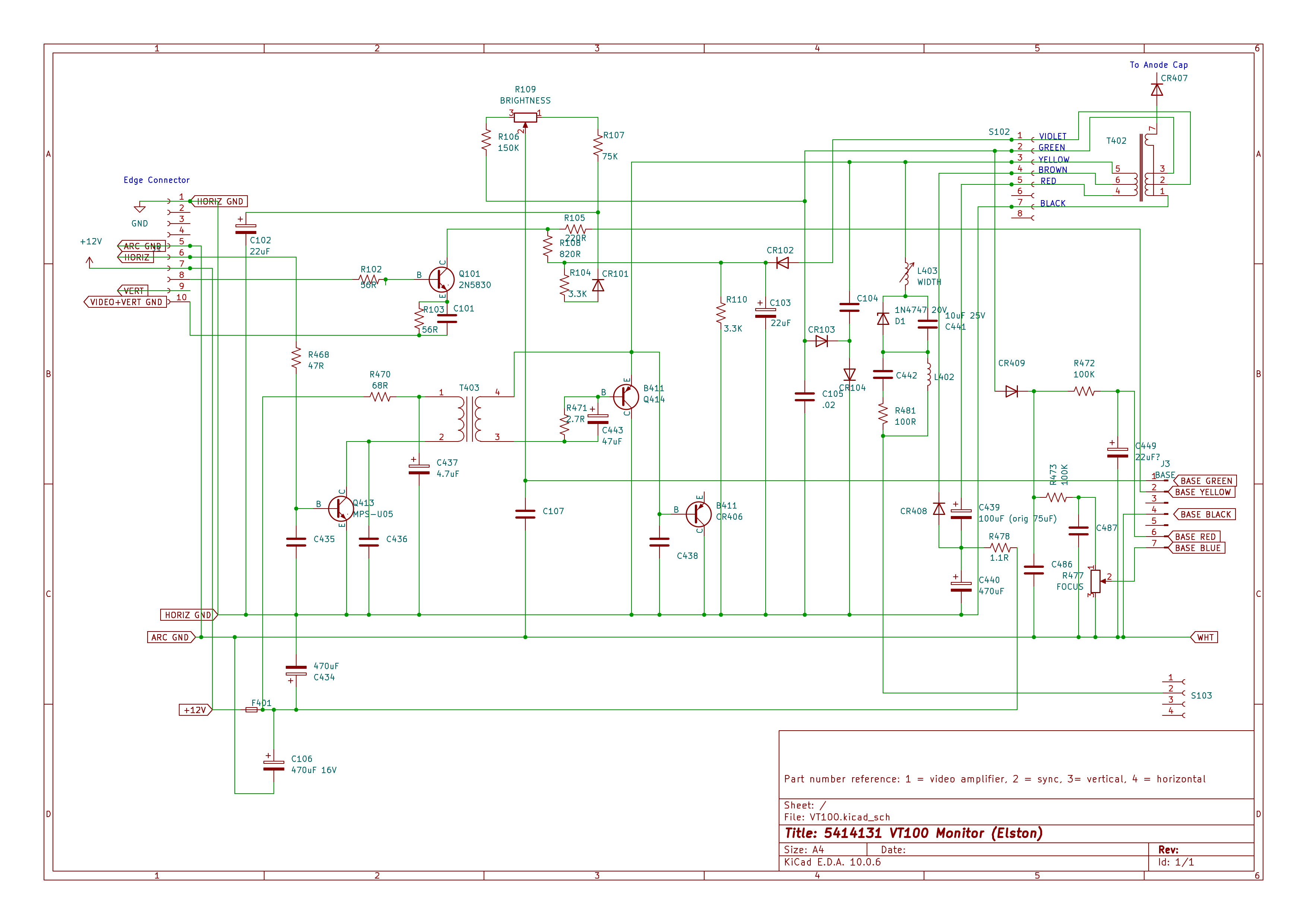
Some time ago I posted asking for help with my VT100 monitor board and
flyback. This is the monitor board that uses Germanium transistors and
for which there is no known printset available. The conclusion was that
the flyback had failed, proved by the burning smell and poor ring test
results, and described at greater length here;
https://robs-old-computers.com/2026/03/30/vt100-video-display-failed-flybac….
I have managed to get a NOS replacement flyback. The ring test shows
that it is good. However, I have enough suspicions about the two
Germanium transistors (Q414 and CR406) that I don't want to just slap it
in and hope it works, especially as I have little chance of ever finding
another flyback. The primary coil of the flyback, driven by these two
transistors, is the one that is shorted in the bad flyback and I don't
know if the flyback failed because of these transistors or not.
Are there any tests I could do on the monitor board prior to fitting the
new flyback? Could I source any kind of modern inductor to act as a
sacrificial part that would be enough to prove correct operation?
I have updated my own reverse engineered schematic
here: https://robs-old-computers.com/wp-content/uploads/2026/09/5414131-partial-s….
This is from a KiCad 10 schematic and I can of course supply that if it
would help.
Thanks
Rob
POWER ON 2026 is officially live!
Every year, the Large Scale Systems Museum asks our community to help keep
computer history alive. This year, we're doing it with our POWER ON
fundraiser.
Your support helps us preserve, maintain, and share our collection of
working historic computer systems and continue making the museum available
to the public.
We've also created some special supporter rewards this year, including our
limited-edition LSSM 11th Anniversary Coin.
There are several ways to support POWER ON 2026, from $32 all the way up to
$2,048.
See all the supporter levels and rewards here:
https://lssmuseum.square.site/s/order?cs=true&cst=custom...
<https://lssmuseum.square.site/s/order?cs=true&cst=custom&item=ZVRQRT72ES3KO…>
We, the volunteers who work on the restoration of these machines, thank you.
Does anyone have one (or know where I can get one) of the 80 pin high
density cables that connects the 16500B main board to the 16500-68733
(16500L or 16500H) LAN/High Speed interface board.
The cable part # is 16500-61607or 16500-61608.
Please contact me off list at bitwiz(a)12bitsbest.com
Thank you,
Mike
Is this email still active?
I found an old old (2016) post about various vintage computers for sale.
I found it specifically looking for a Poly88 - my "white whale".
While I'm sure that one got sold, if you're still active, and you have
any leads on a Poly88, please let me know!
Thanks,
Andrew Pullin
Hi everyone,
I may have asked this before, I can't remember...
I have a PDP-11/23+ pieced together on an H9276 backplane, sitting on the
floor. I have rigged
some fans to keep it cool, but I would love to have either a complete
BA11-S box, or the H9276-B
cardcage for it. The cardcage doesn't have to have the backplane since I
already have one.
Does anyone have either of these that they'd be willing to part with?
I am located in the US.
- Peter
As far as the Poly 88 is concerned, I probably have at least 3 in
various states "buried" someplace. I sold the most complete one some
number of years ago.
Along a similar vein, I probably have the worlds largest collection of
remaining original Poly docs (a three drawer file cabinet) all organized
by part number I obtained after Poly closed their doors. Note again,
they are organized by part number rather than description. If anyone
needs copies of the docs, let me know the part number, and I can check
to see if I have them. Additionally, I have a bunch (100?) of partly
build S100 cards. I took some of them to VCFMW a number of years ago,
but there was little interest in them.
Marvin, KE6HTS
On 9/24/2026 10:00 AM, cctalk-request(a)classiccmp.org wrote:
> Message: 8
> Date: Wed, 23 Sep 2026 21:10:27 -0700
> From: Andrew Pullin<pullin(a)berkeley.edu>
> Subject: [cctalk] Re: Computer for sale
> To:cctech@classiccmp.org
> Message-ID:<7e84838a-78f1-4592-965d-9e2a2742dd23(a)berkeley.edu>
> Content-Type: text/plain; charset=UTF-8; format=flowed
>
> Is this email still active?
>
> I found an old old (2016) post about various vintage computers for sale.
> I found it specifically looking for a Poly88 - my "white whale".
>
> While I'm sure that one got sold, if you're still active, and you have
> any leads on a Poly88, please let me know!
>
> Thanks,
> Andrew Pullin