I think we have some old Mac programmers here.
I've dusted off some code that allegedly compiles with CodeWarrior Pro 2, and
it needs CWGUSI, so I installed 1.8.0 (which was on the CW Pro2 Tools CD).
A bit of hacking and everything compiles, but it won't link; it's missing
a symbol _Stdout that CWGUSI apparently requires (I traced it back to a couple
fflush(stdout);
calls). I've got SIOUX, the Metrowerks Standard Library and everything else
I can think of, and while everything else builds, I can't seem to find the
lib with this mysterious _Stdout symbol. Any guesses? Does this sound familiar?
--
------------------------------------ personal: http://www.cameronkaiser.com/ --
Cameron Kaiser * Floodgap Systems * www.floodgap.com * ckaiser at floodgap.com
-- Do I look like I just fell off the turnip truck?! -- Ryoga, "Ranma 1/2" ----
Hello, everyone...
I may have asked here many years ago about this:? Does anybody? have a
binary distribution of Octave for VAX/VMS?? The sources for some early
versions were distributed in the SIG tapes, but I never managed to
complete a VMS build using them.? I tried tracking old octave archives
with binary builds, but they're all gone (it used to be at
ftp.chem.wisc.edu).? I even tried to contact John Eaton about this but
got no response.
Regards,
Carlos.
The guy posted today, saying they're still available...
- John
>From: <highpwr at bellsouth.net>
>To: <greenkeys at mailman.qth.net>
>Date: Sun, 27 Dec 2020 18:23:31 -0500
>Subject: [GreenKeys] Equipment Available
>
>I have the following available for pickup in the Knoxville TN area, it from
>the estate of an old ham buddy that's now in the nursing home with
>Alzheimer's. All was salvaged from his property which was sold to help
>defer his nursing home expenses, and was going to go in the dumpster.
>Really just wanted to save this stuff from the dumpster, and its free to a
>good home, BUT if it works for you (whomever comes and get this stuff) a
>donation that I could forward to his Nephew to help cover his nursing home
>costs would be greatly appreciated.
>
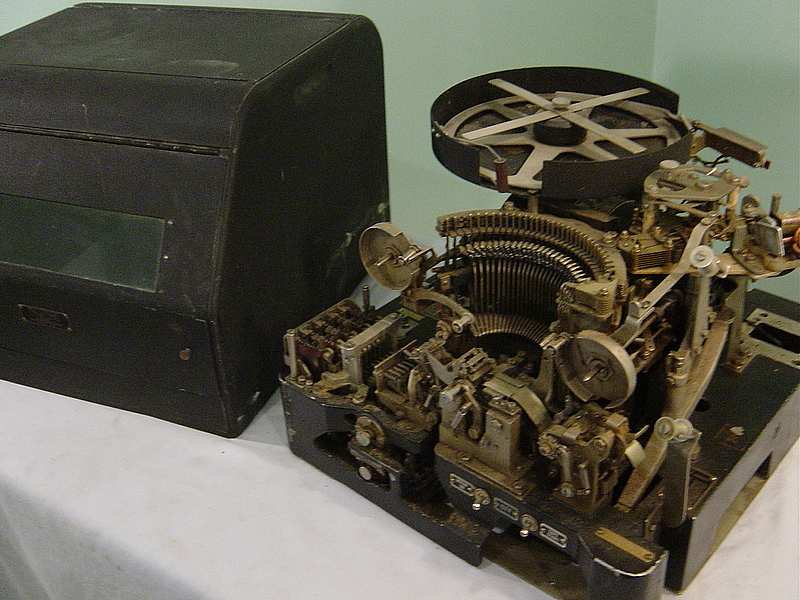
>There are two Teletype Model 35 KSRs and at least one 33 KSR. Also there is
>an model 14 Printing Reperf FRXD (very similar to frxd-1311-04.jpg (800?600)
>(navy-radio.com) <http://navy-radio.com/tty/reperf/frxd-1311-04.jpg> on
>Nick England's site. There may be some other in the future and possibly
>some 11/16 paper tape, but this may be spoken for.
>
>All was stored in a dry outbuilding, but was in the building for well over
>twenty years. It took the best part of a day to dig it out, salvage and
>carry it out of said storage building.
>
>
>
>
>I can provide additional more detailed photos if required, but please don't
>ask unless your really interested and serious. The empty brass nor the gun
>they were fired in are no longer available I'm keeping it.....Ha Ha.
>
>PS this stuff will not be available indefinitely, I don't have the space to
>store it for another twenty years, it will probably go onto the dump or be
>dismantle for parts before the end of February.
>
>Steve
>KM4V
I know it exists, or existed, as there are references all over to it from
the skeletal remains of various BeWare mirrors. However, the package itself
has disappeared. The Intel version is marginally easier to find but if anyone
knows where the *PowerPC* one is (I'll take R3 or R4) please advise.
I guess, since I've got mwcc on it, I could try to reconstruct it, but I
don't know if I would have all the BeOS-specific changes.
--
------------------------------------ personal: http://www.cameronkaiser.com/ --
Cameron Kaiser * Floodgap Systems * www.floodgap.com * ckaiser at floodgap.com
-- My opinions may have changed, but not the fact that I'm still right. -------
This is highly annoying. Back in 2015 I did exactly this and now I have
forgotten how.
I dumped a set of RX02 disks with catweasel into .DMK and now I want a raw
sector image to be able to test them with SimH.
What is a good tool to use? I have some faint memory of glancing through
hexdumps of .dmk files. Perhaps I did something myself using dmklib by Eric
Smith? Don't really remember, unfortunately.
But surely someone else has already done this, right?
/Mattis
Hi all --
Making some progress with the "fire sale" PDP-11/70. Over the past month
I've rebuilt the power supplies and burned them in on the bench, and I've
gotten things cleaned up and reassembled. I'm still waiting on some new
chassis fans but my curiosity overwhelmed my caution and I decided to power
it up for a short time (like 30 seconds) just to see what happens. Good
news: no smoke or fire. Voltages look good (need a tiny bit of adjustment
yet) and AC LO and DC LO looked good everywhere I tested them. Bad news:
processor is almost entirely unresponsive; comes up with the RUN and MASTER
lights on, toggling Halt, and hitting Start causes the RUN light to go out,
but that's the only response I get from the console.
I got out the KM11 boardset and with that installed I can step through
microinstructions and it's definitely executing them, and seems to be
following the flow diagrams in the engineering drawings. Left to its own
devices, however, the processor doesn't seem to be executing
microinstructions at all, it's stuck at uAddress 200.
In the troubleshooting section of the 11/70 service docs (diagram on p.
5-16) it states:
IF LOAD ADRS DOES NOT WORK AND:
- RUN, MASTER & ALL DATA INDICATORS ARE ON
- uADRS = 200 (ZAP)
THEN MEMORY HAS LOST POWER
Which seems to adequately describe the symptoms I'm seeing, but as far as I
can tell the AC and DC LO signals are all fine. (This system has a Setasi
PEP70/Hypercache installed, so there's no separate memory chassis to worry
about.) I'm going to go back and re-check everything, but I was curious if
anyone knows whether loss of AC or DC would prevent the processor from
executing microcode -- from everything I understand it should cause a trap,
and I don't see anything in the docs about inhibiting microcode execution.
But perhaps if this happens at power-up things behave differently? And the
fact that the troubleshooting flowchart calls out these exact symptoms
would seem to indicate that this is expected. But I'm curious why the KM11
can step the processor, in this case.
I'm going to wait until the new fans arrive (hopefully tomorrow or tuesday)
before I poke at this again, just looking for advice here on the off chance
anyone's seen this behavior before.
Thanks as always!
- Josh
Recently acquired an ASR33 with an old EIA (RS-232) Interface convertor
module. ? It came with a two page spec and cable pinout sheet that is
more hole than it is paper. Manufacturer is United Data Services (UDS)
in Phoenix.? Model seems to be 312 A 0568? (might be 0563)? Google
hasn't been much help and Bitsavers is silent as well..? Herb Johnson of
Retrocomputing.com has 312 A 0567 which appears similar but not close
enough to be useful.
Anyone familiar with this unit who could share docs??? (willing to scan
and share if desired)
Steve
Looking at the DEC Pro documentation there's some ambiguity I'm trying to figure out.
The hard drive documentation talks about the "reduced write current" signal. In one place it's explicitly described as relevant to the RD50 only. But later on in the RD50/RD51 chapter the signal is described generally, without any indication that RD51 ignores it.
Does anyone know which is correct? If RD51 also uses it, how does the right value get set? What IS the right value, anyway?
paul
Thanks!??
The radio site aside? from? using low bit rate scan also I think compresses the pdf files.
Ed#
On Wednesday, February 3, 2021 J. David Bryan via cctech <jdbryan at acm.org; cctech at classiccmp.org> wrote:
On Wednesday, February 3, 2021 at 9:25, ED SHARPE via cctech wrote:
> Indeed this site is great for reference but alas are too lo-res for good
> museum display images.
They appear to be scanned at 150 dpi.
The ones here are scanned at 300 dpi:
? http://hparchive.com/hp_journals
? ? ? ? ? ? ? ? ? ? ? ? ? ? ? ? ? ? ? -- Dave
>
>
> Date: Tue, 2 Feb 2021 09:19:08 -0800
> From: Al Kossow <aek at bitsavers.org>
> Subject: Flip-Chip selloff
>
> I don't have any equipment that uses them any more, so I'll be ebaying off
> my
> A-W series flip chips over the next few days. The W's and PT08 boards are
> up now
>
> https://www.ebay.com/itm/184647476832
> https://www.ebay.com/itm/184647420812
>
I am still maintaining a PDP-8/I & TC01, PDP-8/L, PDP-8/S, PDP-9 & TC02,
and PDP-12 for the Rhode Island Computer Museum.
The RICM would happily accept any donated FlipChips, especially the go-fast
B versions and anything else for the PDP-9. You can even get a charitable
tax deduction for the donation.
--
Michael Thompson